
Kipling Said to Stay Away — But Can I?
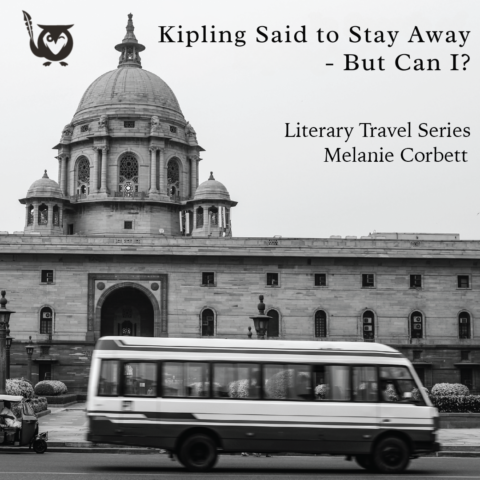
Image by Ankit Verma from Unsplash
There are few things I love more in this world than an old book. But five years ago when I went to University to do my Masters at 50 years old, I discovered the joy of the online library, filled with old and new books alike. Now that love lives on, deepened by a seemingly unlimited source of new inspiration. It’s like a Wonderland for nerds.
I also like to get out of the country and jet off to somewhere completely different for around six months of the year. I am not rich — in fact, I retired at 50 because I wanted more than just the 9 to 5, and that meant minding costs. So, I must be a frugal traveller: I need to plan, but spontaneity can get in the way.
Sometimes I just buy flights to somewhere I have never been before — disappearing on the “no-plan plan”. Earlier this year, whilst sitting in a hotel lobby in Laos, I bought some well-priced tickets for this September to Delhi, a decision that will mark my sixth trip to India.
But despite these many adventures, I have yet to make it to the east side of the country, where I truly wish to go.
For me, Calcutta — now called Kolkata, and the centre of so many stories — is at the top of the “must see” list. It is more than “just” a destination, and more than a place I remember from childhood on my “jig-map of India”.
India as a whole seems to stir up a narrative. For the British, the Calcutta of old will always be of interest as a part of our Nation’s history. It reaches out to me, both because of my nationality and because of my love of old literature.
In my “Wonderland” of books I find Rudyard Kipling writing in 1888 about Calcutta. In his City of Dreadful Night, he says:
“Let us take off our hats to Calcutta, the many-sided, the smoky, the magnificent”.
It’s actually no secret that Kipling hated Calcutta. In the second part of Death of a Lesser God, set in the 1950’s Calcutta, author Vaseem Khan echoes Kipling’s feelings, describing the city as:
“Once a pestilential riverine swamp, infested by bamboo jungles where tigers roamed freely, snacking on unsuspecting locals”.
This is not normally the sort of narrative which inspires one’s desire to go and visit a major city! But I’ve always had an interest in the history and events of the British Raj — and from the beginnings of that institution, Calcutta stood apart as its commercial capital, the centre of “British India”.
But this year, in preparation for the trip that would finally happen, I found myself completely absorbed in the 300+ pages of the Reverend W.K. Firminger’s Thacker’s Guide to Calcutta.
Written in 1906, this old book is completely unlike travel guides found today. This is no Rough Guide or Lonely Planet. This contains no information on places to eat or sleep, nor any detailed travel advice. No, this is a history book; and what a history!
Thacker’s Guide to Calcutta tells me that throughout the 19th century, Calcutta grew rapidly, becoming the second most important city in the British Empire, after London. For a time it ranked within the 12 largest cities in the world, and it became the capital of India in 1772.
What a place that must have been! A centre of commerce, of spice, and of tea trades. Add into the mix the heat, disease, and Victorian Britishness — the European traditions with laced up corsets, tailored suits, and top hats — and perhaps one might get a glimpse of that “pestilential riverine swamp”.
It was British arrogance at its apex, on a quest to educate and control the “natives”, and it would never happen now. Back then there was no desire to maintain, preserve, or even respect the native peoples’ way of life. Those things were irritations, in the way of “Progress”, and they were simply ignored in order to further the financial rewards.
But today’s Kolkata is no longer the capital of India. Delhi has held that claim since 1911, in a move fuelled by a growing nationalist movement and resistance to British rule. But, even after the city lost its crown, it remained for many years India’s largest in both size and trade.
Today, it has slumped to India’s seventh largest city by population, and sixth by GDP. Despite the fact that Asia leads the world in 21st century economic growth, last year the British Airways announced that they would no longer be running a direct service to Kolkata, preferring instead to use hubs at Hyderabad and Bangalore.
Perhaps I should rethink my plan and go somewhere where the lights burn more brightly? Is the Calcutta of memory moving backwards, getting lost behind the Kolkata of today? Is it steadily sinking into the decay I have seen so many times in so many other “previously glorious” places in Asia?
But was it “previously glorious”? After all, in the late 1800s, Kipling likened Calcutta to “Sleeping with a Corpse”. What is the Kolkata of the 2020s going to be like?
Perhaps it’s not faded splendour, but just evolved?
I am not expecting Kolkata to have the vibrancy of its past glories — real or imagined. Time moves along, and things change. The partition of India, various wars, communist rule, and the businesses and industries that left — these all triggered a decline in the economy, and in the associated, rampant unemployment.
As I look forward to this trip, I caution myself that Kolkata may be in many ways similar to Delhi, with the same grime, dirt, and chaos of any large, old city. But, I also hope that it will be more relaxed than some of the more modern Indian Cities I have visited, and that it might stand as a strong, proud link to its colonial past.
I expect Kolkata to live up to its nickname: The “Heart of India” or “The City of Joy”. I expect this city to tell me tales, show me sights, and enable me to understand its history — how it has grown into a fusion between Indian culture and philosophies, and European traditions and architecture.
I want to learn about this development and see those old buildings. I want to wander around them and try to feel the history. Is it still smoky, as Kipling said? Is it still magnificent?
And, I want to ponder what Rev. Firminger would have thought of the city, more than a hundred years after his own original publication. Where might he and Kipling agree? Where might I differ?
But what I do know already is that I love India and its people, and I can’t wait to go back!
Craving more? Here’s a few more stories and musings from the MockingOwl Roost!
- Love of a Lifetime – A Time Travel Romance short story
- Silence Can Be More Telling – A heartfelt story of healing from the loss of a child
- Caught Between Sunset and Moonrise – A travel adventure
- This Land Which Built Me – A poem about the life within a land
🍵 We run on pure passion here at the Roost and every bit of help goes a long way! If you’d like to support our on-going efforts to keep our publication free for everyone, consider fueling us with a digital tea.

Melanie Corbett
Melanie is always hatching a plan, prepping for the next adventure. And always on the move, looking for a reason not to go home — not just yet, there are still things on her to-do list!
Follow more of Melanie’s adventures on Passport Passenger.