
A Review of The Bride!: Does Violence Help Visibility?
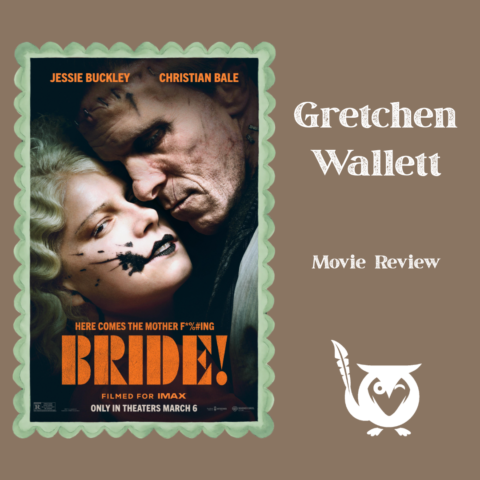
Image from IMDb
As a lifelong fan of the novel Frankenstein, by Mary Shelley, and a lover of old monster films, I was cautiously optimistic when I saw the first trailer for The Bride! as well. Written and directed by actress Maggie Gyllenhaal, the film promised to be a reimagining of James Whale’s Bride of Frankenstein, despite its setting in 1930’s Chicago and its feminist slant.
The trailer showed a frenetic film, influenced by the gender challenges many women still face. And it featured many of Gyllenhaal’s talented inner circle, which lifted my hopes even higher.
But life circumstances kept me from seeing it in theater as planned, so once it became available on HBO Max, I jumped at the chance. I’d kept myself in a blackout on this film so I could react without influence — I hadn’t even read a review or spoken to a friend about it.
But for all that anticipation, the film that I watched ended up as a mixed bag of great and not-so-great ideas, all blended together into a confusing experience that took me a few days to sort through. While I believe it told its story successfully, it left me feeling a little empty as well.
Ladies’ Time to Shine
Whale’s Bride of Frankenstein focuses on the monster and his desire to have a mate created for him, and Gyllenhaal’s The Bride! essentially begins the same. However, the events after the bride’s creation differ strongly. While Whale felt that the monster required rejection and ultimately a lonely death, Gyllenhaal had other plans.
The film’s cold open shows our bride-to-be, Ida, sitting at a 1930’s bar table with a group. Suddenly, as in the original film, we cut to Mary Shelley, who tells us she has more to tell, is stuck in Limbo until she can do so, and is now ready. She then possesses Ida’s body at that table and begins to speak through her.
As Mary, Ida reveals secrets, then challenges a man at her table. Her date pulls her away, and, in a scene of intense violence, he and several others begin striking Ida to get her to “snap out of it”, before pushing her down the stairs. Several parts of her body break on the way down, shown in the film in agonizing, slow-motion detail.
We move from there to meet our “monster”, Frank — played by Christian Bale — as he meets with Dr. Euphronious — played by Annette Bening. Dr. Euphronious is an expert in re-animation of small mammals, and she recognizes Frank for who he is.
Frank spends many days convincing Dr. Euphronious of his agonizing loneliness, and he tells her that she alone can solve his dilemma by creating a mate for him.
Together, they disinter a woman’s body from a pauper grave — the murdered Ida — and begin the re-animation procedure. But Frank is terrified. Ida’s beauty, even in death, has convinced him that she will reject him instantly.
When Ida wakes, she has no memories. Frank and the doctor rename her Penny and tell her that Frank is her fiance. Frank attempts to speak with her, becomes desperately nervous, and flees, leaving Penny confused.
This is where the new version makes a completely left turn from the original. In Whale’s version, the bride rejects the monster outright, leading to several deaths, including the bride and the monster. But Gyllenhaal offers them something more.
Frank and Penny venture out into the world together. He takes her to the movies to see his favorite movie star, Ronnie Reed, a polio survivor known for his dancing skills and played by the director’s brother, Jake Gyllenhaal. Penny then takes him to an underground club, where she dances for him.
At this club, a few patrons get handsy with her, provoking Frank until he violently kills them. Frank and Penny then go on the run together, making headlines as the “Monster Couple”.
For the next 45 minutes, we follow our couple in a stylized tribute to Bonnie and Clyde, right in the middle of this Bride of Frankenstein remake.
As they jump around the country together, we soon meet another couple: A detective, Jake Wiles — played by Peter Saarsgard — and his “assistant” Myrna — played by Penelope Cruz — who brings the real brains as well as the film’s ultimate resolution.
A Confusing Re-Interpretation
After watching The Bride! and spending many days pondering my thoughts about it, I am still not one hundred percent sure — which may have been the point of the film. It’s also difficult for me to say if a single character fully earned my appreciation or respect.
When an author doesn’t provide an obvious hero, it forces us as the audience to sit with our feelings and draw some of our own conclusions — including the idea that maybe no one is good. The cinema in the 1970s and 1980s played this theme well, but modern cinema tends to prefer stronger character delineation.
Gyllenhaal does a lot of things well, especially the larger inclusion of Mary Shelley, but ultimately I did not enjoy the execution of her character in the writing and performance. A literary traditionalist would likely not approve either, as anachronisms abound in this interpretation of Shelley.
But the characters of Frank and Penny are fleshed out well, and each develop in their own right. Gyllenhaal does her best work as a writer when she is developing the characters through their interactions. Even when the dialogue falls flat, the characters stay connected through their mannerisms and blocking.
I take strongest issue with the violence, and in particular, its insistence on graphic violence directed toward women. I understand the metaphor and the obvious desire to reference the Me Too movement in this film. At one point, our Bride even screams “Me Too! What about Me Too?” But at what point does the violence towards women no longer act as reclamation?
I am a horror fan, be it book or movie. I’m not squeamish about film violence when it feels appropriate. So I’ve struggled with this caveat in The Bride! Should we lose count of how many bullets are put into a woman? In one scene, I did. That feels excessive, and I fail to see how it gets the right point across.
And yet, I loved the chance to see Gyllenhaal direct again. Where her writing flails, her director’s eye rises above. Visually this film is lush and gritty at the same time, just how I would expect life to feel at the beginning of Chicago’s gangster movement.
Trigger Warnings
Before you decide to see this film, take some time and research its trigger warnings. As I said, I went in blind, and the suddenness of the extreme violence proved a shock. A warning might have helped me better prepare myself, so I’ve listed the most triggering issues below:
Sexual Violence & Abuse
- Sexual Assault: The film depicts multiple instances of non-consensual sexual harassment and assault. This includes women being groped, surrounded, and chased by men.
- Sexual Abuse by Authority: There are explicit depictions of sexual assault and rape, including an armed authority figure overpowering a victim.
- Exploitation: The story heavily features themes of misogyny, the undermining of women, and men attempting to control or coerce the female protagonists.
Violence & Gore
- Graphic Brutality: The movie features brutal murders, shootings at close range, and characters having their faces stomped on until pulped.
- Body Horror: Expect to see severed body parts (including jars of severed tongues) and characters falling to their deaths.
- Gore Effects: There are depictions of open, oozing wounds and exposed internal organs.
You can find multiple other reviews that discuss these triggers further at the following pages:
Should You See The Bride!?
If you choose to watch The Bride!, get ready — it’s not what you think it will be. I leave it to you to interpret the ending and the thematic choices made, because ultimately, I think that’s the prime take away of this film: How did it make you feel?
There are definitely worse ways to spend two hours, but go in cautious and aware. I love to support new female voices behind the camera, and Gyllenhaal has a great career ahead of her as a director.
In homage to Domestic Violence Awareness Month, the MockingOwl Roost has additional material and resources to offer.
- Domestic Violence is Real – A spoken word performance urging cessation.
- Divergent Memory of a Burning Heap – A memory. Not all violence leaves physical bruises.
- I Remember – A poetry reading in honor of Domestic Violence AwarenessMonth
- Smiles – A protest poem.
🍵 We run on pure passion here at the Roost and every bit of help goes a long way! If you’d like to support our on-going efforts to keep our publication free for everyone, consider fueling us with a digital tea.

Gretchen Wallett
Gretchen Wallett has a Bachelors in English from Indiana University and a masters in Library and Information Science from Drexel University. A life-long reader, they are passionate about spreading the love of reading and access to information. They also enjoy writing about books and researching topics of interest to them. They live in a cozy little cottage in Indiana with her partner, Steven, and their two cats, Simon and Lil Bit.