

Trad Wife by Saratoga Schaefer: A Review
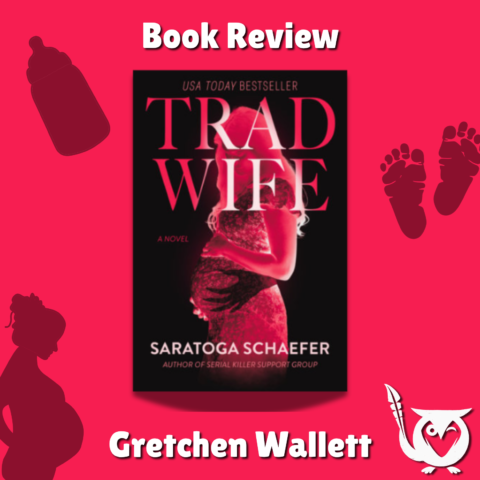
Book cover image from Penguin Randsom House
Before its release in February of this year, Trad Wife by Saratoga Schaefer created a lot of buzz within the book community. One reviewer said it was the “Rosemary’s Baby for the digital age.” Being a fan of Ira Levin’s 1967 novel, I quickly put the audio book on hold with my library so I could read it as soon as the release happened.
If you are chronically online, you have surely heard about the trad wife phenomenon. For those who are not aware, “trad wives” are a subset of influencers who showcase their lives as traditional homemakers and focus on homemade baking, child care, and homesteading.
While most of these influencers do not care for the moniker, it has gone into the zeitgeist.
There was another book about a trad wife released recently, Yesteryear by Caro Claire Burke — it tells the story of a trad wife who is transported to the 1850s. This book has stirred up a lot of feelings on Booktok, the TikTok book community. Many complain they cannot enjoy the story because the protagonist is too unlikeable.
I was concerned Trad Wife might be the same case, but Schaefer manages to avoid this trap by keeping our protagonist three-dimensional. Readers may not agree with everything she says, but she is a developed character that we can relate to.
Enter the World of a Trad Wife Influencer
Our story centers on Camille, an influencer in her mid-twenties. Through her internal monologue, we learn her mother died when she was eight and her father forced her to become the domestic caretaker for him and the house.
In her teens, Camille rebelled and went to college. She was accepted into a prestigious STEM program, but cracked under the pressure and returned home. Soon after, she meets her future husband, Graham, and dedicates her life to being a wife and, hopefully, mother.
The novel is set in the countryside in a farmhouse the couple just purchased — Camille stays home while Graham commutes to the city for work. She spends her time decorating the house, baking sourdough bread, churning her own butter, then posting curated pictures on Instagram to garner followers and thousands of likes.
Camille has everything she thinks she wants, but something is still missing — a child. Everyone she follows and admires has children, and although she has been married several years, they have not been able to conceive.
Making matters worse, Graham has been home less and less since the move. When he is home, he is distant and on his phone constantly, making conception even less likely.
After several failed attempts to seduce her husband, Camille is despondent. She knows she would be the perfect wife if she had a baby. Without one, she is an incomplete woman, a failure in her eyes.
It is during their move that Graham determines she does not need a car, so she is left alone in the house most of the time. Her only exercise is walking around her property.
Although Camille has been warned by locals to avoid the woods behind her house, she ventures in anyway. There, she finds an old, decrepit well. Camille fishes out a penny and makes a wish to have a baby.
After her wish, strange things happen on her property; an entity begins to follow her and plague her dreams. She sees an eye that repeatedly asks her if she wants a baby — and she always answers yes. After a humiliating exchange with her husband, the entity enters the house.
Camille sees a dark and nebulous creature with black wings in her doorway. Her instinct is to call it a monster, but she recalls a memory where Graham explained angels often present themselves in terrifying forms. She tells herself the entity is an angel and she invites it to her bed.
She conceives a child and the gestation period is swift — leading to questions from the few people in her life. She soon gives birth to a daughter and her life is altered in ways that lead Camille to take charge of her life for the first time.
Is Trad Wife Really the Rosemary’s Baby for the Digital Age?
We can be sure Trad Wife could not exist without the presence of Rosemary’s Baby. The two novels share some plot points and themes, particularly the feeling of domestic dread and the loneliness that can come from being a housewife. Both protagonists spend significant time alone before and during their pregnancies.
Rosemary’s circumstances are all caused by outward influences. She is not given the means to make any choices until the end. Camille, on the other hand, is influenced by internal forces. Her desire for a child allows her to make decisions for herself and leads to her situation. Although she is a “trad wife”, she has agency.
Rosemary’s character from the 1960s would never be afforded such autonomy. This makes Trad Wife feel fresh and modern instead of a copy or an homage. Camille’s ability to choose the trad life or to leave it sets her apart from Rosemary, and calls attention to the inherent flaw in the trad wife aesthetic. Modern women have options that true traditional wives did not.
At its release, Rosemary’s Baby was considered a psychological horror. All of the tension and scares are generated from Rosemary’s thoughts and experiences.
Trad Wife is a modern body horror novel and may not be for the squeamish, though horror fans will enjoy the carnage candy. The fear and dread we feel comes from Camille’s changing body and what that means to someone who is obsessed with physical perfection.
Should You Read Trad Wife?
There has been debate about the ending of this novel on whether the ending is happy or sad. I stand firmly in the happy camp, as the ending was the resolution I predicted and wanted. While it may be unconventional, it is the best outcome in my opinion.
If you are a horror fan, I would heartily recommend this book to you. If you are not a horror fan, but are interested in stories about the modern feminine experiences on its fringes, I would encourage you to step out of your comfort zone and give it a try.
The novel is a slow burn to start, but this allows us to really get to know the characters, especially Camille. However, I would avoid this book if you have issues with reading about infertility, cannot handle animal horror, or intense and graphic scenes.
Looking for more like this? Try these:
- The Night Library at Sternendach — A Vampire Opera Novel Review – A Paranormal Book Review
- Book Review: Extasia – A Feminist and Horror Book Review
- My Body – Poetic Words About Pregnancy and Society
- Dear Sara – A Poem of Motherhood and Change
🍵 We run on pure passion here at the Roost and every bit of help goes a long way! If you’d like to support our on-going efforts to keep our publication free for everyone, consider fueling us with a digital tea.

Gretchen Wallett
Gretchen Wallett has a Bachelors in English from Indiana University and a masters in Library and Information Science from Drexel University. A life-long reader, they are passionate about spreading the love of reading and access to information. They also enjoy writing about books and researching topics of interest to them. They live in a cozy little cottage in Indiana with her partner, Steven, and their two cats, Simon and Lil Bit.