

Rockhound
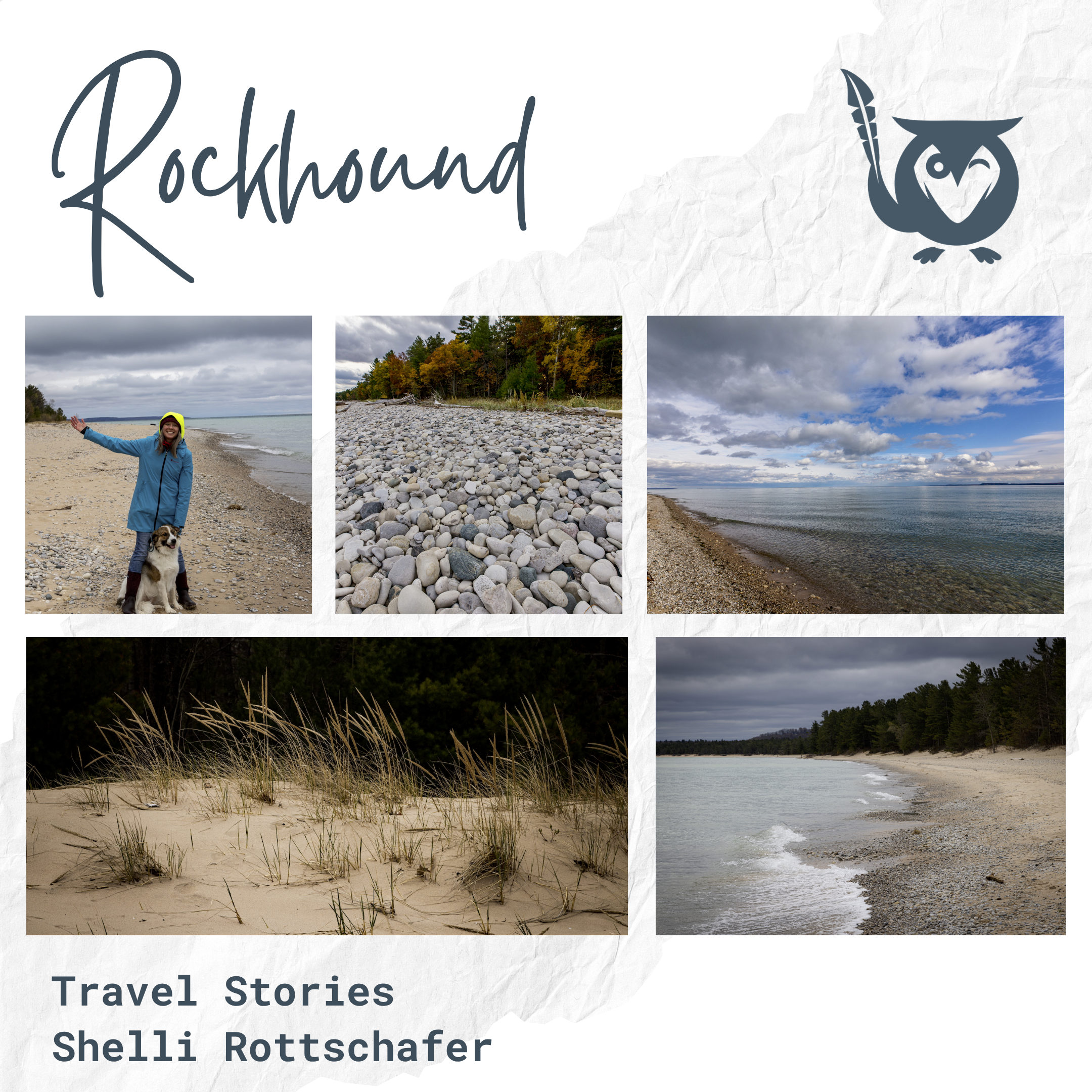
Images by Author
Many grow up with the lure of a prized treasure hunt. Perhaps, it is the “hot-cold game” when a parent has littered about the house cherished vinegar-dyed hardboiled eggs, jellybeans in plastic fake grass, or chocolate bunnies whose ears are quickly nibbled.
But for me, my preferred treasure hunt was of a different kind. As an adult, I have learned the term, “rockhounding.” And yes, I readily hunch my shoulders with my head bent toward the ground. And I can imagine that the curvature of my spine looks like one’s hound on their morning walk doing their morning business.
Yet no, my sniff is for something else, rocks pebbled out on beaches. The treasured prize – Petoskey Stones.
It’s easy to forget that the Great Lakes Region was once an ancient ocean. During the Paleozoic Era, the sea advanced and receded multiple times, leaving behind colored layers of waterlines that reveal fossil remnants of ancient marine organisms. The Petoskey Stone’s honeycombed patterns are what I am after, a fragment of fossilized coral.
These precious finds always emit a squeal of delight; “Look! Look what I found!” I yell as I clasp the smoothed shape in hand. To pass its litmus test, one licks the stone or gently bathes it in shallow water to expose the five-sided contiguous pattern of coral-turned-stone.
The best places to scavenge these treasures are oft my favorite beaches to comb or where a tug on my heartstrings has passed — all of which hover along the 45th Parallel.
Thunder Bay is one such place. This beach, beyond the quarry and gravel pit in Alpena, Michigan, is littered with pebbles the size of paper weights. Red granite sliced with chartreuse crevices, sandstone perfect for skipping across calm bay flats, or a prized Petoskey.
It is here I walked with a child’s hand grasped in mine, trying to be a failed stepmom that never came to be. It is here my heart was cleaved, hoping to be something I could not. Instead, I plunked those Petoskeys — discarded like ballast stones — so that I would not sink like the shipwrecks off those shores.
On the other side of the state along Lake Michigan — south of Petoskey State Park, and south-west of the municipal marina — curves a limestone beach that extends out to the Petoskey Harbor Light. Fishers often come here, headed out to cast upon the pier, followed by tourists with Kilwin’s Ice Cream cones in hand, always dodging the crescendo-ing waves.
But those in the know, instead of turning right onto the pier, veer left. Down beach rests another hidden resting place: the cemetery of the old mission church.
The St. Francis Solanus Church was the first Catholic Mission dedicated to converting the Odawa. The land was originally “purchased” from the Odawa by a French-Canadian Voyageur, Jean Baptiste Trotochaud.
From Trotochaud, Bishop Baraga acquired the beach-front where indigenous trappers would bring their birch-bark canoes to the French in order to parley business.
The mission church stands today, as well as several white crosses that rise upon unmarked graves — most likely indigenous parishioners who contracted small pox and other European diseases they had no immunity against.
This resting place looks out into Little Traverse Bay and into the Big Lake — michigami. It is a reminder of who has been and who will be, as the old mission is now surrounded by luxury condos on its street-side with vast steel-blue waters upon its frontage.
Here, when you sit in the sand and feel it trickle through your fingers, one can’t help but comb through the grains and find a stone-honeycomb-relic reminding you of that passage of time.
Finally, there is Good Harbor which crescents parallel to Bohemian Road Beach. South of the town of Leland, Michigan on M-22, the road will lead you through deciduous forests, onto gravel road, and then toward the secluded beach. To gain access, you have to cross through a tree-line that morphs into dune grass, and then the Big Lake.
Out far into the bay, you can easily see South Manitou Island. This passage between island and mainland shore was once notorious for shipwrecks because the shoals deceive where it seems deep water should be.
Here, sandbars stretch far and create warm shallows. The water is crystalline and is often compared to Caribbean Blue. The taupe-white sand reveals her maritime secrets with beach-glass worn smooth and chipped ceramic dinnerware from lost ships’ cargo.
The Big Lake gifts her natural resources of Petoskey stones and an amateur rockhound gleefully exclaims, “Look. Look what I found!”
Enjoyed this? Check out some of these pieces from our other talented writers!
- Traveling Back in Time with Outlander – A Literary Travel Moment
- Rising Tide – Poetry
- Storm Season – My Favorite Things
- Bermuda Nocturne – Poetry
***
🍵 We run on pure passion here at the Roost and every bit of help goes a long way! If you’d like to support our on-going efforts to keep our publication free for everyone, consider fueling us with a digital tea.

Shelli Rottschafer
Shelli Rottschafer (she/her/ella) completed her doctorate from the University of New Mexico, Albuquerque (2005) in Latin American Contemporary Literature. From 2006 until 2023 Shelli taught at a small liberal arts college in Michigan as a Spanish Professor. She also holds an MFA in Creative Writing with a concentration in Poetry from Western Colorado University, Gunnison (2025). Now she lives and writes in Colorado and New Mexico with her partner and their rescue pup.
Find more from Shelli on her website.