

Alim’s Eid
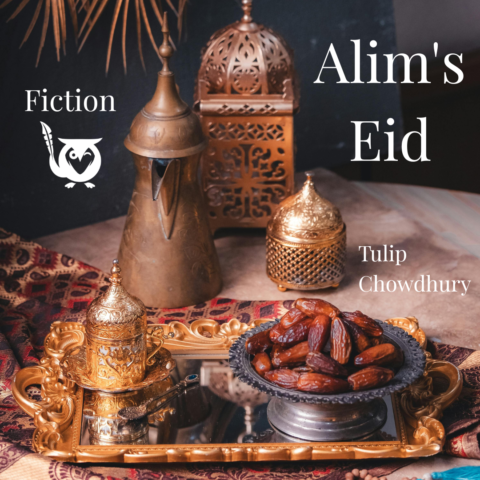
Image created on Canva
On the morning of Eid-ul-Fitr, a great day of festivity in the city, Alim was out on the streets early. Carrying a jute sack on his shoulder, he hoped to collect more trash on this particular day: People cleaned up their houses for Eid, and that meant they might throw out more trash than usual.
Alim was one of the many homeless children roaming the streets of Dhaka, Bangladesh. Beyond his first name, he had a street name: “Tokai”. A general term, it referred to the younger homeless boys who collected odds and ends from household trash. Now 10 years old, Alim had seen his father, Motin, collect trash with his jute sack from his earliest memories.
His father’s livelihood consisted of collecting trash to sell to a small business owner who dealt with recycling. But Motin had no known last name, and neither did Alim. Living on the streets and looking forward to a meal or two a day with money earned in selling the trash didn’t require paperwork — and no last names either.
When his father had died a year back, Alim inherited the sack and began to work as his father had. Then his mother remarried and disappeared — Alim had not seen or heard from her for the last ten months, and now believed himself to be all alone in this vast world.
The day before, Alim had wanted to purchase some soap to wash the only half-pants and T-shirt he possessed. But he had not been able to sell his plastic bottles, nor the small pile of papers he had collected. The man who usually purchased Alim’s trash had left to celebrate Eid in his village home. So, Alim wore his dirty clothes. Maybe they had a foul smell, but he was used to it.
And even when his nose did wrinkle at the smell, his other senses told him to accept it — it was a part of his life. So, his momentary wish to wear clean clothes on the day of the Eid coiled back on him, emphasizing once again the helplessness that had come with being all alone out there in the world of poverty.
Alim could make no celebrations for Eid, but watching the festivities take place on the streets provided a change in his monotonous life. By mid-morning, the people going in and out of their houses looked busy. They bustled about their homes, getting ready for the great day while Alim stood in the corner of a street.
All around him, new apartments with beautiful gates loomed tall. The new buildings had replaced the old single- or two-story houses that lined the streets only a couple of years back. Most of the balconies of the apartments swarmed with children screaming and shouting down to the street.
Their joyful shouts added yet more reminders of the special day. Alim watched them, and noticed how they sparkled in their new clothes. He sighed, wondering how it would be in a home like that of those children.
“They must have had some shemai. Maybe their lunch will have some special rice with pulao chicken,” Alim said wistfully to himself.
The stories of rich people came to him from other Toakis, whose mothers worked as house help. Envy sparked inside his longing soul, though he tried to push it away. As Alim looked on, a few mothers appeared on the balconies and pulled their children inside, probably for their baths.
Alim wondered if they would use expensive soaps. When he had been about seven years old, he and his parents had lived together in a slum. His mother had bathed him with soap on Eid days, and given him fabulous, clean clothes — clothes that smelled of detergent and felt so fresh.
The pleasant memories lit his eyes with a light far beyond his sight. He looked up at the sky, searching among the thin clouds for a refuge from his present longings.
Maybe, he thought, up there is a God who will one day pity me and let me have a happy Eid. He looked at the gates of the apartment buildings again.
Most of them were closed, with security guards standing in front, their arms crossed. They seemed to him like symbols, declaring that happiness held nothing but closed doors for him. All the people in the apartments could be happy — they could celebrate Eid with new clothes, soothing baths, and good food. But not Alim.
And yet, by irony of fate, he had at least found something new to do: He could watch these people celebrate the day. Even the guards standing around the entrances of the buildings wore freshly washed and starched uniforms. They too looked happy — probably because they would receive tips for Eid and have good food from the inmates of the house.
Alim wondered if he would ever get a job like theirs. If so, then he could wear bright clothes like theirs and have some money in his hands, too.
A gust of wind blew down the street, tossing and turning the boughs of the tree that sheltered him. The wind brought a refreshing coolness, but also reminded him of the coming winter. He shivered despite the warmth as he remembered that he had no warm clothes.
But then he thought of his jute sack. He could cover himself with it at night when he slept on the streets. Other Tokais who did not have the sack shivered throughout the cold winter nights — if they survived at all. Alim relaxed a little. His sack provided for him, and his sack could protect.
But he continued to just stand there in the corner of the street. What else was there to do?
Two gentlemen, laughing and talking, walked by along the opposite side of the street. They had two small boys in tow, each clinging to his father’s hand and wearing bright white pajamas and punjabis. All of them had nice Eid caps on their heads as they made their way toward the morning Eid congregation.
Alim put his hand up on his bare head and wished he had a cap so he could go with these people and attend the Eid prayer. Earlier, he had given this matter some thought, but without clean clothes, he had given up the idea.
His hands clenched at his side, and Alim looked away from the people, ashamed of his poverty, aching for answers. Why did God, the Creator and controller of all things, give to some while leaving others without even a home or food?
Poverty made him see life as black and white. Either people had or did not have, and that inner, constant question of, “Why me?” threatened to consume him.
So, there Alim stood on the day of Eid, as crowds of happy people passed by. Pangs of hunger gnawed through his stomach. He had found nothing to eat the night before; his most recent meal had been a piece of bread that a shopkeeper had given him the previous afternoon.
And then, without warning, an elderly security guard standing by the gate of the building across the street called to him.
“Hey there, come here, boy.”
Alim cringed, sure that the man intended to tell him to go away, to take his filth far from their beautiful gates. But he obeyed, and as he drew near, the man smiled at him and held out some shemai on a piece of paper.
“Here, eat this. Somebody from the building gave me some, and you look so much like my own son — take this and eat it.”
Alim took a closer look at the man. Yes, he did look kind. His offer was true. Alim held out his hand and took the shemai. He tried not to eat it quickly. He tried to savor it and make it last, but it disappeared from the paper almost before he had felt its weight in his hands.
The guard continued to stare at Alim. “You must be very hungry,” he said. “Wait, let me see if I can get you more food from the first floor. The people in that house are kind.”
As the guard made his way up to the building, Alim felt a lightness growing in his body and soul. He imagined the special rice and chicken given out on a real plate. Perhaps they would share a korma curry or polao, dishes that were more dream than reality for him. Maybe there would even be some beef too.
For the first time since his parents had been gone, he began to see a hint of the light of God. Maybe God did remember him after all! Alim settled down on the steps of the building’s wide driveway.
Where do I wash my hands? He thought as he waited for his food — good food which was coming soon. His mouth watered.
The guard returned. Alim looked at his hands, but they were empty.
“I am sorry,” the guard said. He shook his head from side to side, frowning, as if he was still trying but failing to solve the puzzle that Alim’s poverty and momentary needs had opened to him. “The first floor’s lady left early this morning for her parents’ house and the maid will not open the door.”
The guard put a gentle hand on Alim’s head and said softly, “It seems as though the shemai is all fate held for you here, after all.”
“Fate?” Alim asked. “Is that what God thinks about when someone wants to feed the poor?”
“Yes, of course. It is God who decides your fate. He will change it if he wishes,” the guard replied as he looked down at the hunger-stricken face of the boy. He sighed. “I wish I could have given you more. Your eyes are so like my son’s.”
Alim felt the corners of his mouth droop, and he turned away before the guard would think him ungrateful. He rose from the steps, picked up his sack, and walked away.
He chided himself as he went. He had forgotten in that small moment that God’s destiny could include going without food, proper shelter, or clothes. He had forgotten that he had been born poor, that sadness was a confirmed part of his life. How could there be even a small spark of happiness unless God intended it for him? He was not the chosen one.
Still, he muttered under his breath, “Why did God let me have a dream of good food? I suppose it is a mistake for poor boys like me to have dreams at all…”
The sun that had started to rise in Alim’s world on that Eid day sank back down, and the world once again turned dark. Slowly, Alim went back to the corner of the street. He continued to look on. The meaning of Eid to Alim was to see what the other people — the people with houses, food, and clothes — did on such special days.
Indeed, Eid held different meanings for different people.
“Perhaps another Eid will be my different one, with me living in one of the apartments,” he said to himself.
Alim thought of what the guard had said. Maybe God would make changes for him.
MockingOwl has many more hopeful stories and essays to share:
- Known – Hopeful poetry of yearning
- My Grandmother’s Hands – Review of a book that offers healing help
- Almost Paradise – Short fiction detailing the finding of hope and joy through nature
- The Need for Expectations – Personal essay about finding hope in varied ways
🍵 We run on pure passion here at the Roost and every bit of help goes a long way! If you’d like to support our on-going efforts to keep our publication free for everyone, consider fueling us with a digital tea.

Tulip Chowdhury
As a contributing writer for The MockingOwl Roost, Tulip Chowdhury’s writing explores life from the trivial to the pivotal, blending the visible with the invisible — like a kaleidoscope. Her favorite leisure activities are reading, listening to music, swimming, and walking in the woods. She lives in Georgia, USA.