
Of Shoes, Snow, and Monkeys in a Hot Tub
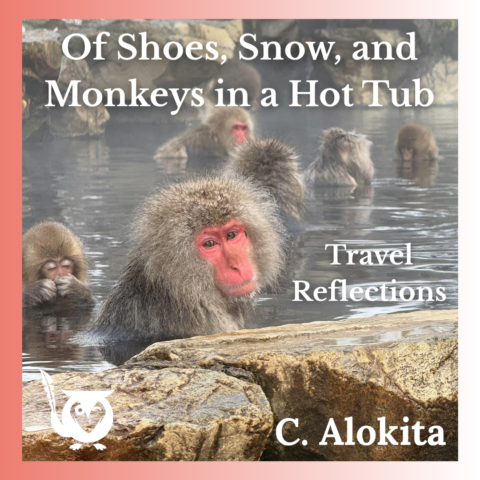
Image created on Canva
A solo trip to Jigokudani, where the monkeys have more sense than I do.
The day before I saw the snow monkeys, I nearly lost my feet. Nah, it wasn’t the frostbite of December, but my own catastrophically misplaced optimism about the structural integrity of my hiking boots.
I was on a snowy trail in Nagano, Japan, full of the particular confidence that comes from being naive about winter hiking, when my right shoe decided it had simply had enough of this relationship and peeled itself off in a dramatic statement of intent. The left one followed shortly after for solidarity, I suppose.
I walked back in what I would generously call “minimal footwear” and what anyone watching would have called “a disaster.” My feet were fine, though; just my dignity took a hit.
I bought new shoes that evening from a small shop near the station, the shopkeeper watching me with the careful expression of someone who has seen many non-natives make poor decisions in winter. I thanked her, and she nodded with great patience.
The next morning, I took the bus to Jigokudani, or Hell’s Valley, with a new pair of functioning boots and zero remaining illusions about my outdoor competence. The forest trail to the monkey park is the kind of path that makes you feel like you have wandered into a folktale, and not necessarily one that ends well for the protagonist.
December’s frost in Jigokudani is not yet the deep snow of January; the trees still hold their shapes clearly, branches dusted rather than buried, the path underfoot firm and navigable. But there is an eerie stillness to it, a hush that feels less quiet and more like something is listening.
Steam rose through gaps in the geothermal vents below, curling upward into the cold air with an unhurried confidence. The whole landscape smelled faintly of sulfur and pine.
I kept half-expecting a figure in white robes to step out from behind a cedar and offer me a deal.
I was, embarrassingly, not entirely opposed to the idea. My PhD research had been going poorly. A youkai kidnapping, I reasoned, might at least come with a change of scenery.
I was on my first solo trip in Japan. I had arrived in the country as a researcher, full of ambition, and had spent several months being systematically humbled by both the language and the experiments. Nagano felt like a necessary exhale; somewhere to exist without obligation, without the particular weight of a half-finished thesis watching me from across a desk.
The trail gave me exactly that: twenty minutes of walking where the only thing I had to do was not fall over. I succeeded. Mostly.
When the tree line opened, there they were — the monkeys! Japanese macaques, Macaca fuscata, in winter are an interesting type of absurdity. Sitting in an onsen, a natural hot spring cut into the side of a rock near the Yokoyu river, they exude the same studious and thoughtful demeanor of profound philosophers.
Steam rises from the surface of the water as snow settles on their reddish-brown faces. Their eyes are semi-closed and relaxed, unfazed by the human crowd’s curious attention. In many ways, the scenario was ridiculous: monkeys soaking in a hot tub and us snapping photos of these nude little furry models. Everyone understood the humor of this on some level.
The mothers of the monkey community interested me most. While some of the adults were chilling in the warm water, the mothers worked. One mother carefully groomed her infant with surgical precision,moving her small fingers through the baby’s fur with such focus. The baby lay passively, never questioning mommy’s love.
The adults did not seem to mind our presence at all. And we humans were not offended but so much impressed by that.
At the main entrance to the park, a road sign almost made me trip. Two signs pointed in opposite directions: “Onsen For Monkeys” and “Onsen For Humans”.
I stood there for a few moments and found myself giggling, just calm enough to contain myself. That was possibly the most reasonable sign I’d ever seen. The monkeys had their bath, and the humans had theirs in a nearby ryokan. Clearly, both baths were deemed significant enough to mark on a map.
There was also a geyser close by, a steam vent raging in the cold air for thousands of years in the volcanic geology. I lingered next to it longer than was probably warranted. There is something about watching the earth vent that makes you feel very small in a way that is, surprisingly, not unpleasant.
The PhD, the failed experiments, and the general low hum of academic anxiety, all of it became briefly, mercifully, the right size in my mind — shrunken, and a long way from being a hot spring in Nagano.
I took the bus back to the town as the light went grey and flat in the late afternoon. My new shoes had held. The monkeys were still in the water when I left, just as indifferent to my departure as they had been to my arrival. The steam from the geothermal vents followed the trail behind me for a while, and then it didn’t.
My first solo trip in Japan, and I had nearly done it barefoot. I had walked a mystic trail, half-expecting to be kidnapped by a forest spirit. I watched monkeys soak in a hot spring with more dignity than I have managed in most professional settings. And I had laughed, alone, at a road sign in the snow.
It was a good day.
Jigokudani Yaen-koen (地獄谷野猿公苑) is open year-round. The monkeys are most reliably in the onsen from December through March. The trail is about 1.6 km from the Kanbayashi Onsen bus stop. Wear shoes you trust.
Eager for more travel related reads? Give these a look:
- The Llama You’ll Never Know – Hiking Machu Picchu
- 25 Budget-Friendly Destinations for the Post-COVID World – World Travel Tips
- Echoes of War: Shizugatake of Japan – Inspirational Creative Travel
- Everyday Travel – Poetry about Commutes
🍵 We run on pure passion here at the Roost and every bit of help goes a long way! If you’d like to support our on-going efforts to keep our publication free for everyone, consider fueling us with a digital tea.

C. Alokita
C. Alokita is a writer by passion. By day she's a scientist, quietly tinkering with chemicals in a lab corner. But by night her literary dreams emerge as she merges cold logic with poetic fire. She's fond of observing the universe, from galaxies to atoms, and believes that the most human thing one can do is leave little creations behind.