
Short Film Review: Gì Cũng Sửa (“Fix Anything”)
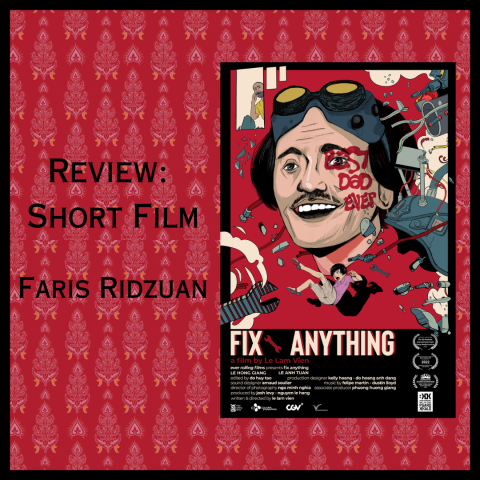
Film poster provided by director LE Lam Vien
Director Le Lam Vien, winner of the Best Director Award in the Singapore International Film Festival (SGIFF), displayed his and his team’s skillful mastery in finding and attempting to grasp at the slippery and elusive meanings of being human in his film Gì Cũng Sửa (Fix Anything).
They combatted the absurdity and supposed total meaningless of life with humour, finding meaning in the very ordinary encounter of a father and son.
The film speaks of the self-defeating revolt of the working class, displaced by modernity by using an aspect of modernity, technology, in an ingenious manner against their perceived oppressors.
Gì Cũng Sửa (Fix Anything) begins by showing a father-son pairing, both encumbered by a myriad of social problems with a focus on them being ridden with debt.
The father is a genius in technology and through humorous moments and much fumbling, he is endearingly subversive as he attempts to erase his debt collectors’ memories of his accumulated and unpaid debt that he might create a new reality.
This made me feel and think about that time when one of my relatives shared about how they were forced to operate a computing system, but they did not know how to do so. They were employed as a driver and this was not part of the scope of their job.
They used the computing system anyway with frustration about doing a job they were not meant to or skilled to do. They ended up wiping out the memory of the computing system instead. They left the company right after the warning pop-up displayed on the screens indicating the memory wipe-out.
While my relative was not technologically savvy like the father who built the memory wipe-out machine in this film, there were similarities. Both my relative and the father in the film wiped out the memories of oppressive systems to navigate around pain and suffering.
Both loved life and knew how to subvert through the technological tools that might be oppressive to those who cannot or did not benefit equitably from technology. Both are archetypal of those who do not own these technologies, the new means of production of wealth and power. Both created a new reality by erasing one and trying to write a new blueprint.
The son first started out as a moralistic or even ethical advisor and voice of conscience. But over time, I started to question the relative points of morality and ethics, especially since the decisions and acts are hinged on trade-offs and perspectives rather than clear-cut judgements based on un-contextualised values, no matter how universal.
What is compassion and how does it manifest to benefit all in a given context? Thus, I realise that in the negotiation, and the humility of the wisdom of the eternal mystery and openness of hearts, judgments of good or bad dissolve into interdependent discernment between father and son.
Discernment which looks at the context in the moment rather than content in totality emerges. The exploration of the deep resonating principle that affirmation of life for yourself, all others and the world is played out in the characters’ roles.
Thus, the characters and we who observe them start to witness rather than impose values and judgements. We examine both independence and interdependence, as we begin to see that we too can participate in such realities.
As I reflected after watching, many existential questions arose for me.
First, I realised that there were a lot of male-presenting characters and a focus on male-presenting gazes in the film. This led me to question whether this was deliberate and if there could have been more attempts to move towards more diversity, or even pluralism, which is the receptive and active observation and participation within and with diversity. What has not been portrayed speaks volumes.
In this case, the blank spaces are the gender pluralism for me. There were many unanswered questions in my mind. Were the father and son blood-related or were they chosen or reconstituted families much like the Japanese film “Shoplifters” that also depicted the perils of poverty affecting chosen families?
Where did the father, who could not eke out enough to pay off his rent, acquire the skills and competencies and even the resources to build such a technological feat?
To what end, extent, or eventuality is the silencing, marginalising, absence and voicelessness of women and other genders an extension of the increasing fragility of the male ego, clinging on to outdated and contemporaneously unethical patriarchy or even misogyny?
How do we begin to face the development and growing push for the emancipation of women and other non-cisgendered individuals through feminism and other liberative movements?
Why did the father not use his ingenuity to invent the marvellous technological tools to actually earn money to pay off his debt, rather than erasing the memories of the debt collectors, which seems less absurd?
Perhaps this thought provoking film does it best with the poignant mono-syllable one-word question echoed at the end. “Home?”
And perhaps we will find more wrestling with all these seeming absurdities, humour, and connections from which deep meaning emerges in director Vien’s future films.
We might explore some kind of northstar in an uncertain world through the claims of truth via imagination, in a world seemingly obsessed with data analytics, statistics, cold-hearted reason and so on.
Through reason, we explore the known and through imagination we create a better world in every moment. That which is beautiful is found in the moment, pulling more beauty towards us without us having to rush to an illusion of a completely planned future from our minute vantage points, and therefore, closed future.
Living in the beauty of the moment frees us from worries of arriving at a dystopia.
But perhaps, we begin by not assuming we know anything and instead, approach life with the adventurous spirit of this father and the son in every moment. That life is truly a mystery.
We might just admit and be comfortable to feel and think ourselves as vulnerable enough to admit that we no longer know much about our home whether past, present, or future. And that is fine.
But to play the game of questions which offer clear cut solutions, when truly there is none which is conclusive, we go down to the ever deepening depths of rabbit holes.
What is home? How do we build it? Why is home important? Who is part of this home? Where is home? When will I be truly home? When will I be truly at home with myself, and with others? What is the home we experience in the moment? How can a future home emerge if we stay in the moment?
What do we need to be and do to be in the moment, and avoid manifesting a gloom-and-doom-home with all our existential issues like climate change, the threat of nuclearisation and nuclear warfare and so on?
What are the plausible homes if we share the moment in interdependence? How can we manifest our inclusive Home, where the many are one?
While we ask these questions and play this game of charades as if there are static solutions and answers, may we be as adventurous in our spirit, body and soul to dive into each moment to create a beautiful world – inclusive, life affirming and empowering to all.
I end with the illusion of separations of selves melting away, as I see the father and son in this film, and you, my friend, reading or experiencing this review of the film Gì Cũng Sửa (Fix Anything), within myself.
Perhaps we might ask ourselves: Should we be fixing anything or should all of us, the many who are truly one, come home to ourselves?
Special note from the director:
The film is currently not available for standard public viewing. It is embargoed. If anyone wishes to view this film, please contact the director at mr.levien@gmail.com for more information.
Vien’s Biography and Filmography
LE Lam Vien participated in both AFA and Talents Tokyo. In 2015, Vien won Best Directing Award at 321 Action National Short Film Contest with the short ‘In Another World’. In 2022, Vien won Best Directing for a Short film award at Singapore International Film Festival 2022 with the short ‘Fix Anything’. From which Vien is currently developing his first feature of the same name.
For more film and television reviews:
- The Stranger in Our Bed
- Amazed By History: My Take on Concrete Cowboy
- Suffragette: the Long March Toward Votes for Women
- Lagaan Knocked It Out of the Park!
- Wonder Woman 1984: The Film I Wish I Could Have Loved

Faris Ridzuan
Faris is a multilingual musician, artist, and writer. He has played roles such as education and youth policy officer, tech product policy manager, branding and curriculum lead, strategy lead, manpower lead, and social science and interdisciplinary researcher. He is due to graduate soon with a Master’s in Malay Studies from the National University of Singapore (NUS), where he tutored Asian and Malay Studies, winning teaching awards. Faris graduated from NUS with a First Class Honours in Sociology, minoring in European Studies. He has been leading national, regional & global initiatives such as Youth Panel Member for AMP 4th National Convention, Global Project Advisor for Connecting Climate Minds, and Co-Lead for Asia, Global Indigenous Youth Summit on Climate Change. Faris was awarded the prestigious NUS Outstanding Young Alumni Award in 2023.
Learn more about Faris on LinkedIn, enjoy his music on TikTokand YouTube and discover some of his research and writings in the publications section on LinkedInand Google Scholar.






3 Comments
[…] Short Film Review: Gì Cũng Sửa (“Fix Anything”) […]
[…] Short Film Review: Gì Cũng Sửa (“Fix Anything”) […]
[…] Short Film Review: Gì Cũng Sửa (“Fix Anything”) […]