
The Sound of Silence
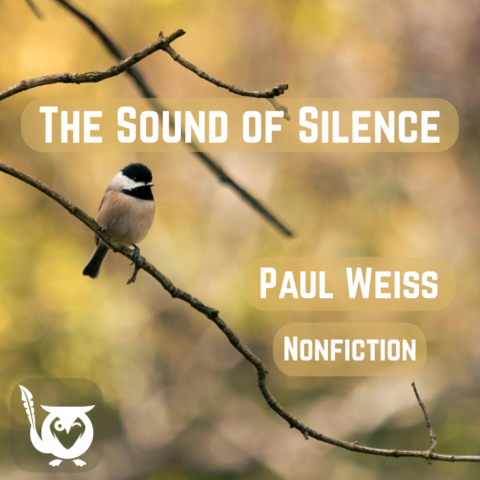
Image created on Canva
(With apologies and thanks to Paul Simon and Art Garfunkel)
Chick.
Chick.
Chick [pause] chick.
Chick-a-dee.
Chick-a-dee-dee.
Chick [pause] chick-a-dee-dee-dee.
The sun had yet to crest the horizon, but the chickadees were already making their presence known with an improvisational performance of a pre-dawn, avian symphony. It was so early that false dawn had yet to lighten the eastern sky — or, put another way, the house lights had yet to illuminate the sylvan stage.
I decided I didn’t have to open my eyes to confirm it. Although the musicians were really only warming up, there was a singular, pleasing tunefulness to the effort.
Bringing one’s self to consciousness under nylon in the pre-dawn forest is a daunting, yet pleasant task, fraught with many obstacles. I mean, we’re not talking Sealy’s PosturePedic mattresses here.
The first order of business is a bit of a stretch, one tiny muscle at a time to work out the kinks of spending an inordinately long number of hours of fitful sleep on the ground: toes, feet, ankles, wiggle, repeat, wiggle, repeat; calf flex and calf stretch followed by a hamstring flex and extension to bring the legs back to life.
Was I ready to subject my arms to the coolness of the morning air, take them out of the sleeping bag, and stretch the upper body with a faux yawn? Not quite yet.
As I lay listening for other musicians to begin their warm-up and join the chorus, it occurred to me to wonder if the chickadees were actually communicating with their calls — to me, or to their partners, flock mates, or young hatchlings — or were they simply vocalizing with the joy of life and revelling in the promise of fine weather to come?
Then the raucous squawk of a passing raven signalled that the symphony of the dark was complete; the chickadee’s overture to the day was reaching its concluding bars.
A sneak peek through the no-see-um netting that I always left slightly open overnight for fresh air now confirmed that the day was starting — but not yet quite in earnest. The house lights now began to dimly illuminate the forest around the camp site, providing shape and definition to what minutes before had been meaningless degrees of black.
A still-brilliant but slightly subdued Venus stared unblinking at me from her position ahead of the yet unrisen sun, and a few shapely wisps of clouds in exactly the right place on that expectant horizon promised a grand and colourful entrance.
Other feathered denizens would soon add their voices to the growing chorus. It was time for that upper body stretch and the first reluctant, tentative walk into the bush behind the tent! Finding the strength to do that always took a mental leap but, having done the deed, my body relaxed and gave thanks for my perseverance. I smiled and, truth be told, sighed in contentment as well!
The reality of camp work began with a couple of trips around the periphery to snap off handfuls of deadwood — the small, exquisitely dry, more dead than alive bits of conifer, most typically pine or spruce, that tenaciously held onto the trunk of a tree under the still-living canopy.
These twigs, a few curls of birch bark saved from the previous day’s travel, and a couple of slightly larger dry branches that I broke off a close-by fallen tree made short work of the morning fire-starting ritual. I could have spent the whole morning mesmerized by the flames, but pulled myself out of its trance as soon as it was beyond the stage of nurturing and feeding.
Well, maybe not quite — I always gave myself the luxury of just a few extra minutes to soak up the delicious heat and allow it to dissipate the morning chill that I still felt on my backside.
Time to think about whipping up breakfast! I had long since given up on the romantic notion of open camp-fire cooking. Pots and fry pans simply got too black, too sooty, and too dirty, and there was always the question of leveled support for a pot filled with steaming water on the boil or a bubbling stew.
Plus, the handle on the pot usually held as much heat as the pot’s base. A careless moment of inattention could lead to badly burnt fingers or a pot of stew upset into an unforgiving fire. And of course, there was always the problem of cooking in inclement weather, too.
My kitchen weapon of choice had become a single, almost pristine pot which I heated, inside the protection of a lightweight wind shield, over a wonderfully low-tech spirit burner filled with methylated spirits. No pressurizing, no moving parts, no priming necessary.
This pot offered just enough vaporizing gas over the burner to start and hold a consistent, dependable blue flame in almost any weather, save the frigid conditions of deep winter camping.
Compared to the likes of a ridiculously high-powered MSR XGK with its two settings — “Off” and “Blast Off” — or even the traditional single-burner Coleman stove, the heat of an alcohol stove was low and slow. It took ten to twelve minutes to bring a litre of water to a rolling boil compared to as little as three to four minutes with the more powerful, pressurized fuel stoves.
But the reward? A blissful, total silence — so complete that I needed to check from time to time to ensure the stove had not been blown out by an errant breeze.
***
Perhaps you’re a beginner dipping your toe in the shallow end of the wilderness pool for the first time, stepping outside of your urban comfort zone and tentatively, even fearfully, indulging in a weekend canoe trip with your buddies that involves a portage or two off of the punters’ beaten track.
On the other hand, you might be an accomplished, four-season, solo wilderness explorer planning a multi-week exploration of an uncharted or unmaintained route that’s an extended exercise in bushwhacking, compass- and map-reading, and risk management!
Wherever you might fall on that wide spectrum of outdoor lovers, campers, hikers, canoeists, or explorers, sooner or later somebody will ask you the inevitable question: “Why?” or “Whatever for??” If you’ve got several days to spare, I’ve got enough answers to fill all of the time that you’ll give me — but, without doubt, one of the answers is silence.
Quiet. Peace. Solitude. The serenity that inevitably attaches to those things.
Silence — or at least what most people understand to be silence — in a populated setting like a city, apartment building, library, or even your own home, is inevitably anything but. In fact, our brains suppress a veritable tsunami of low-grade white noise and teach us to ignore it to the extent that we convince ourselves that in such a “quiet” setting, there is no sound.
It’s almost constant: the drone of street traffic from an endless stream of tires on nearby roads; the flow of water refilling toilet tanks; a refrigerator or a water heater turning itself on and off; the ticking of analog clocks; or the high speed whir of fans and the movement of air in a heating or air conditioning system.
Even the creaks and groans of the ever contracting and expanding materials of buildings; the electric buzz of high tension transmission wires; or the clicks of burners on stoves inundate the silence around us.
If you live near an airport, the bass rumble of powerful jet engines taking off or landing is a part of your daily experience. So too may be the rhythmic clickety-clacks or the painful squeals of steel on steel generated by trains passing on a nearby railway track.
And yet, for most of us, that avalanche of sound doesn’t even register in our conditioned minds.
In true wilderness, silence is pervasive and complete, so complete that it might actually be characterized as deep or embracing, and, to indulge in an unanticipated oxymoron, perhaps even loud in its own way! But that silence doesn’t stultify or oppress, as if smothering one in a terrifying world of sensory deprivation.
Rather, wilderness silence serves as an open gate, allowing the other sounds — those most often covered by city noise — to be heard, to enter our stream of consciousness, to be questioned or interpreted and, above all, to be appreciated.
Although I pride myself on my ability to converse on a wide variety of topics, one of the beauties of solo travel is that I’m rarely tempted to entertain myself by holding forth on both sides of a conversation out loud.
So, other than the occasional grunt of exerted effort, an exclamation of surprise or pain, or perhaps the relief of a belch, most days pass in complete silence on my part — and that is the point! Make no mistake: If you insist on being a noisy paddler or hiker, entertained by the sound of your own voice, that’s what you’ll get — and only that.
But, perhaps more to the point, you’re likely to frighten whatever might otherwise have made a sound into the sensible silence of the wild. And if it leaves your area, the opportunity to listen will disappear.
The sounds that walk through the gate that a wilderness camper has unlatched and opened are the sounds that will bring comfort with them. These are the sounds that, in their brief happening and passing, will leave behind a measure of joy, comfort, and serenity — feelings that we can then take back to our embattled workaday world.
***
With the stove now quietly working its magic on the pot of water, I stood up and carefully stretched again, this time from head to toe, working out the last few left-over kinks of my night separated from the hard-packed forest floor by only an inch of inflated foam mattress.
Then, for a second time, I walked into the forest behind the tent, this time to retrieve the coffee and the breakfast oatmeal, already mixed with a generous helping of raisins, slivered almonds, and brown sugar, that still hung in a dry sack carefully slung almost twenty feet in the air between two trees.
Chipmunks, squirrels, raccoons, and even passing bears are impossibly acrobatic and ingenious in their attempts to pilfer provisions from a camper who takes shortcuts. As I released two half-hitches and unwound the rope to lower my stash to ground level, the campsite’s resident squirrel, thwarted in his thieving efforts, unleashed a barrage of chittering and scolding.
Nonetheless, I offered him a smile as he skewered me with a cold glare and a continuing stream of furry invective. As I walked back into camp, I surreptitiously dropped three or four peanuts on the ground, quite certain that, at some point during the day, the squirrel would find them and think himself most clever at having ultimately outsmarted me.
Fed and watered, I mentally pulled up my departure notes: Fire well doused; camp-site checked and re-checked for litter or other items that I had no wish to leave behind; pack well-centered in a canoe now lined up beside the shore and ready to launch; resident squirrel no doubt pleased to bid me goodbye — all check!
The sun had risen with a light that offered a tenuous promise of some pleasant heat later in the day. But it had not yet reached a level that could warm the atmosphere or clouds. Not even the mildest of breezes stirred.
The lake shone, a polished, shimmering mirror that beckoned me onward. If I could prompt my muscles into sustained, rhythmic action quickly, then I could drive my canoe ahead of the ripples its motion created.
This meant that for as long as the calm in the air and that motivation in my body lasted, I would be granted the privilege of paddling on that mirror, without distorting the portion of its surface yet ahead of me. Beginners may take it on faith — and my experience knew the truth of it — that this was a blissful state of affairs indeed, and one not often granted.
One foot centered in the canoe and one foot on shore! As I pushed away from land, balanced and carefully preparing to draw my trailing leg fully into the trim seventeen-foot craft — the observation post from which I would watch life around me for the next two or three hours — my gate of silence granted admission to one final sound before I reached open water.
Late last evening, I had discovered a moose cow and her yearling calf sharing a piece of my shoreline. They had now decided that their timeline was no longer restricted to the water.
Placidly, powerfully, and with a grace that belied their awesome size, matriarch and son, the largest mammals — aside from dad, of course — in their local boreal domain, marched up from their bountifully stocked larder, onto the shore, and into the darkness of the deeper forest.
An abundance of water cascaded from their bulky shoulders as they cleared their throats and nostrils with moist, grunting, deep-throated exhalations. Their unconcerned retreat into the forest, marching not so much past as through anything that opposed them, would have made any marauding bulldozer proud!
In a few brief moments, the resonating sound of snapping branches and twigs and of hooves on soil, stones, and glacial outcroppings slowly dwindled until it passed beyond my ability to hear it.
Life was good and I now paddled onto the lake.
Several hours and kilometres later, I opened up my tinned mackerel-and-tomato shore lunch. Then a performer, whose enchanting song I had hardly dared to hope would be part of today’s symphony, made its belated appearance on the wilderness stage.
For many years after this accomplished musician had first thrilled me with his virtuosity, I had wondered how the pristine wilderness of northern Ontario could be home to so many empty oil drums, steel culverts, Quonset huts, or metal drain pipes.
For surely, I thought, this ethereal, staccato series of spiralling-downward trills, with its distinct metallic echo, could not possibly originate from anywhere but inside such a container. No matter where I hiked or paddled throughout the north of Canada, this gifted musician never failed to find a performance venue whose echoing acoustics amplified the package.
When I discovered its name — the Veery thrush — and then from there, the cause, my mouth fairly dropped in amazement. This so readily identifiable echo was due to the veery’s extraordinary ability to use its specially constructed vocal tract. It sings two different notes simultaneously. The veery is singing in harmony with itself — in effect, a solo duet!
Imagine a single member of the orchestra playing a violin and viola simultaneously to create a descending series of exquisitely difficult and rapid staccato arpeggios. I’ve heard that song many, many times since I discovered the biology and physics behind its production, but I relish it on every occasion.
Minutes stretched into hours. My shoulders began telling me that my day on the water had reached an end. Time to pull up, set camp, and pour myself a generous cup of — sadly! — lukewarm vodka.
Tilting my head to one side, I listened as the dusk and gathering clouds provided a sombre, dampening effect to the forest’s overture of tonight’s improvisation of “Moonlight Sonata”. Day sounds, whether enjoyed from an open canoe on a lake or underneath that canoe on a sweaty portage, are notably different from their dusk-to-dawn counterparts.
The soft, soothing, comfortable sound of the loon’s hoot, as the male and female of this year’s partnership keep each other and their vulnerable chicks rallied together, soon gives way to the male’s recognizable and markedly more aggressive, signature calls.
His haunting wails, yodels, or tremolos that lay territorial claim to the lake he grudgingly shares with me this evening, can raise a shivering frisson of gooseflesh up the spine of even the most experienced backcountry canoeists.
Night is now inevitable. Light dwindles as the house lights go down, and dusk edges into a blanket of darkness, a state that Shakespeare described as “death’s second self that seals up all in rest”.
I would respectfully disagree. I think it’s a pretty safe bet that the bard never spent a night under nylon, listening to the sounds in the Canadian bush.
Now that you’ve had a chance to rest in the sounds of this piece, try a few more MockingOwl articles!
- Caught Between Sunset and Moonrise – A travel blog from the sea.
- Tulatulahan, Parts 1, Part 2, Part 3, Part 4, Part 5, & 6 – An exploration of life in the remote Philippines.
- Squirrel – A fictional showdown between a man and a squirrel.
- Cormorant – An ode that’s for the birds!
***
🍵 We run on pure passion here at the Roost and every bit of help goes a long way! If you’d like to support our on-going efforts to keep our publication free for everyone, consider fueling us with a digital tea.

Paul Weiss
Paul is a senior male, gracefully (but all too quickly) aging with a partner of 40 years, and a jack of many trades — though sadly, a master of none. He enjoys accounting and finance, applied math and theoretical physics, adult coloring, music and choral singing, backcountry wilderness travel and navigation, and photography — and he always combines those with a fondness for habitual reading and reviewing. Currently, his country travel-count has just passed 40. If he can reach 50 or 60 of them before he leaves this embattled vale of tears, he’s sure he’ll go happy.
Follow Paul on Facebook.